Thursday, June 23

Iles de Paris

I grounded in Paris on June 12th and since then I've been in the process of settling into a work routine... french-style. 

First Paris. The city is a pleasant realizations of many of my expectations. For example, within 5 minutes of getting off the train from the airport, I saw a man riding a bicycle in a striped shirt with a baguette in his basket. People walk slow, dress creatively and pause often, and at every turn there's a landmark that makes you want to pinch yourself. Old infrastructure and graffiti abounds. Yes this is Paris. 

The Fete de la Musique is an international street music festival that was started in Paris and was on June 21st. We rendez-vewed with friends from the landscape architecture school in Versailles for a 'pic-nique' along the Seine, then caught some of the performances that were going on all over the city.  


Wednesday, June 15

The Land of Smiles

I should clarify my writing is a bit behind the times. Three days ago I arrived in France and coincidentally celebrated exactly one month of travel. More on this later.


Thailand

Where to start.

I started, like most people do, in Bangkok. It’s big, noisy and hectic at first glance. The city’s infrastructure is right there for you to see. Electric lines shoot everywhere and curl around your head as you walk down the busy streets. There are night markets, day-time markets, markets in alleys, and markets that block the sidewalk and flow into the street - you can get your anything here. Practice haggling before you come, it’s important when it comes to doing business from a tent. If Thai food, religion, and dress has been translated and used by hippy culture, Khao San Rd. in Bangkok is where it comes back together. There were some people who seemed to have come to Thailand and never left.


Tourism is one of Thailand’s top industries. In Bangkok people developed very creative schemes to make the most of this industry. Tuk-tuk (motorcycle taxi’s) rides will deliver you unexpectantly to their business partners’ shop and several others having to do with visiting a temple that go something like: ‘Happy Buddha. Only for today.’ We went to the Grand Palace, where the King of Thailand still resides. Thailand is a constitutional monarchy so while there are pictures of the king on elaborate arches all over the country, there are also candidates’ election billboards as well.


Chiang Mai and north-west Thailand is geographically and historically very different from other parts of Thailand. There are many languages spoken by Thai people that separate in some ways the cultures of NE, NW, Southern and Central Thailand. The city of Chiang Mai itself is very old. During our stay, they were celebrating the Intakin Festival and the 700th birthday of their city wall. The festival was held at a temple that housed the city pillar. Most Thai people are followers of Theravada Buddhism. Wat’s, or temples, are centers of worship where monks of some monastic orders practice.


To break the tourist circuit, Jan and I went on an excursion on scooters for a few days. The roads were a little intense and the signs less than helpful, but with help from friends we met along the way we made it to some hard-to-get-to places. Besides tourism in Chiang Mai, Northwest Thailand’s economy is primarily agrarian and we passed many farms growing rice, bananas, and beans. The tropical environment helped spawn some incredible things (to a girl from upstate NY). In general things just seemed bigger, from the elephants to the giant bugs.


Phuket, in southern Thailand, is a center for tourism. Crazy tourist beach culture can be pretty alienating and we didn’t stay long. The islands and small towns of southern Thailand are incredible with their mostly sand beaches and limestone cliffs and rock formations. Kayaking and Thai longtail boat are both good ways to explore the area from the water. Many parts of southern Thailand were devastated by the 2008 tsunami. Tourist boats were left far inland by the waves and some still remain there.


Wednesday, June 1

Last Stop Beijing

Bi Ran’s friend picked us up at the airport and we got a splash dive into Beijing food with a super spicy meal. Frank’s Red Hot has met it’s match.


We started off exploring the Summer Palace, which translated means the Gardens of Nurtured Harmony. As we walked around, I kept being reminded of Olmsted’s Central Park with its blowing willows, organic paths and pools of water. The palace’s central feature is Kunming Lake. Emperor Qianlong, who started work on the property in 1750, traveled and transposed elements of other landscapes. There was Hangzhou’s causeway and a mini Suzhou. Everywhere we saw images of the dragon and golden roofs, both symbols of the emperor. There were also phoenixes, representing the power of the empress. Empress Dowager Cixi spent much of her time at the palace. She seemed like quite the control freak with an unmatched superiority complex.


In Beijing we set up visits with three of the top Landscape Architecture School’s in the country. At Beijing School of Forestry, Bi Ran’s alma mater, we gave a talk and sat in on an evening lecture by Sun Xiaoxiang. At 90, he is the oldest ‘student’ of Landscape Arch. and still very passionate about it. According to him we should be five things; a poet, a painter, an architect, an ecologist, & a horticulturalist. I have much to aspire to.


We paid visits to and talked with students from Peking University, connected with the firm Turenscape and watched a lecture on boundaries at Tsinghua University. Both programs had strong focuses on sustainable design.


The 2008 Olympic site is still very much buzzing with activity. The giant infrastructure is still used for sports and its shear size brought people like us there to gawk. Is this what the future looks like? Side-note; apparently it is a practice in schools and many workplaces to begin the day with a series of exercises, common to the entire country. We watched on and tried to take part as a group of waiters did them in Bi Ran’s first plaza design.


Tiananmen Square, the largest square in China, is across the street from the Forbidden City. It was the imperial palace from Zhu Di of the Ming Dynasty to Puya of the Qing Dynasty; 1402 to 1912. If you’ve watched the movie the Last Emperor, its that one. Now the colors are less intense but the buildings themselves are still just as grandiose. Many buildings were rebuilt after 1860, when Anglo-French forces burned much of the imperial palace as well as Summer Palace.


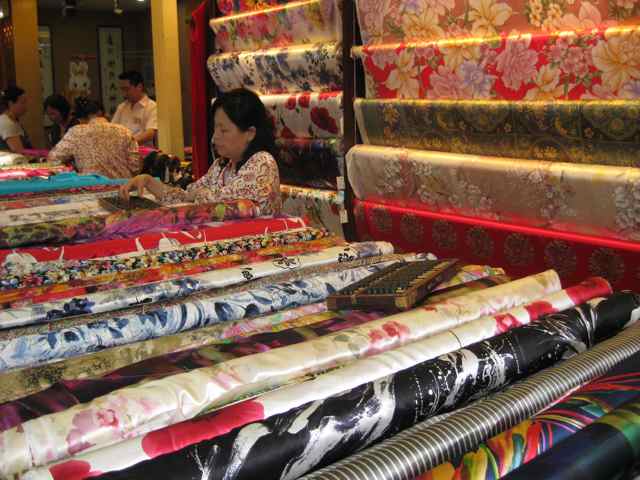
Culture is rich in Beijing. We visited many market areas where traditional practices such as jade carving are passed on to family members. We visited a 100-year old peking duck restaurant, silk stores, a Chinese medicine shop and chopstick manufacturers.


The Beijing Botanical Gardens are incredible. They have a rich diversity of plants, are well laid out and have a greenhouse with an excellent tropical and arid plant collection. We came in time for the rose festival and of course, we stopped and smelled them all.


The art/industry district 798 etc. was the last stop in Beijing. It’s a place where old factories have been converted into art galleries and studios and other factories are still running. This culture clash is a must see.


Traffic made more sense in Beijing. The subway infrastructure was older, dating back maybe to the ‘90’s, and there were plenty of crosswalks and trained drivers. To date, Xi’An’s traffic is the most insane I have seen.